
So guess where we're headed today, then!
I suddenly remembered - it's Bonfire night, isn't it? Blimey. Seems odd, that. Hope you have (had) a good one.


Above: the views from my window. Looks like Bonfire-night-weather ot there, too! Still, even if it stays smoggy, it won't really matter today.
Chi and the taxi driver collected me at 8.30. Another very pleasant and cheerful lad. He would stay with us all day. On the way to the Emperor Qin's Mausoleum (near where the Terracotta Warriors are located), we visited the
Banpo Museum. This is built over a 6000-year-old stoneage settlement - which therefore pre-dates the Qin by some 4000 years! The guide book has quite a lot to say about Banpo, but in view of the large amount I have to get through today, I'm only posting a few photos. They show some of the burial chambers and a full-scale model of what part of the settlement may have looked like.


And so, on to the Warriors. The scale of the museum site is already large, but it's under continuous development to cater for the ever-growing hordes of tourists. There are those (Chinese mainly, I suspect) who say that this is now the most popular archaelogical site in the world. They could be right, but fortunately it's a Monday, and we arrived early. Always a good idea, that!
To begin with, this is what the Emperor Qin may have looked like:

Qin reigned from 246 BC but died young: aged 37. Nevertheless, he'd planned his burial down to the finest detail. The Terracota army was only one small part of his lavish preparations, intended to give him eternal protection and immortality. But his rule was a cruel one, it would seem. The thousands of common-labourers whose sweat and toil went into the enterprise were despatched without ceremony or gratitude. Many of their remains have been found in several "satellite" pits - crude burial pits, with one piled on top of another. It is even said that at least some of the warriors were literally modelled on live poeple - who obviously didn't remain in that state for long. Certainly, each figure does appear to be unique in its features and stature.

Above: the main entrance to the site.
The warriors that have so far been discovered are in three huge excavations ("pits") located some 1.5 km from the burial mound that marks the emperor's tomb (mausoleum). The tomb itself remains sealed at present: until the international archaelogical community is satisfied that it can be opened without fear of damage to its contents. This will depend mainly on the availability of suitable conservation techniques and technology. Mistakes were made during the initial excavations; for example, many of the original finds were brightly painted, but with direct exposure to daylight their colour has been largely lost.
Pit #1, where the initial finds were made, is housed in a vast hangar. The picture below fails hopelessly to convey the scale of it:

But maybe you'll get some idea from the fact that all those tiny dots along the side walls are people!
The figures were discovered by pure chance by a local farmer who, in 1974, unearthed part of one while digging a well. Prior to that nothing at all been had known of this amazing royal custom. Incidentally, here's a nice touch: apparently that same farmer often visits the museum. Of course he's getting on in years now. He's rightly treated as a national hero. Before 1974 Xi'an was a rather down-at-heel place, I gather; few lay people ouside of China had even heard of it. Now everyone knows about it. Not only that, but Xi'an's old city, with its impressive and largely-intact fortifications, is very striking indeed: the "magnet" of the Terracotta Army has triggered a thriving tourism industry here too, making Xi'an probably the most properous city in the region.
And at last, here are some of the shots you've been waiting for!


On the way round we met this charming retired gentleman from near Shanghai, who'd travelled here by himself to see the warriors.

Above: this is one of many figures from Pit #2, the roof of which is leaking. They had to rescue the finds, and some of them are currently on display in more conventional museum-type surrounds. There were not just warriors buried in the pits either, but ranks of horses and domestic animals, too. Even fully-rigged chariots.

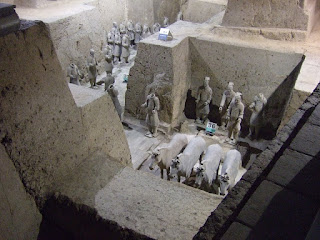


These shots are merely the tip of a huge iceberg, of course. The number of figures discovered in Pit #1 alone runs into thousands. (I myself have taken a mere 250-or-so pictures today.)
And here we are outside again.

Then the three of us had lunch - noodles - on the way back into Xi'an. This is our driver:

Once back in Xi'an we took a walk in the old city. This is known as the
Goose Pagoda:

And in the gardens of the pagoda ther is a series of moderb scultures depicting traditional life and customs. This chap is a fortune-teller. Notice the Yin and Yang sign on his tablecloth.


And here's a wider view of the area.

The haze never really goes aweay now, which rather spoils the effect.

Above: the approach to one of the city gates. We are about to ascend onto the walls.

Ont the top, looking back to the gate.


Looking down onto a new housing estate inside the walls.
As it startred to get dark, the loghts began to come on. This is looking along a main secton of wall. You can see the many gate-houses disappearing into the distance.

Looking at this picture should give you a good idea of how substantiual the walls are. The width of the road is the thickness of the wall. And the walls have been restored so that you can go right around the old city. There are little shuttle buses that, according to Chi, take an hour to do the complete circuit.
Gradually, the rest of the city's lights began to shine.


That was it. After a long but fascinating day, it was time to go and eat.
Then, something of a crisis struck: on returning to my hotel room I found a note from Reception had been slipped under my door. It said Caroline had phoned from Knutsford to say that Expedia had managed to mess up my hotel booking in Beijing, and could I check my emails.
You bet I did! Good job I had an Internet connection.
It seems that The Tianlun Dynasty - the hotel I had booked with them many months previously, and that had been confirmed - was now closed. Expedia were offering me an alternative which was (apparently) paid for, plus £40 in compensation. My new hotel would be The Regent, Beijing. I was to confirm my agreement to the switch by email which, again, you can be pretty sure I did -
pronto. Bear in mind that my flight up to Beijing is the next day.
Then Caroline and I independently checked the Tianlun Dynasty's website. It clearly stated that - as from July 2007 - the hotel would be closed for refurbishment for several months and that they would not be taking bookings.
July. But Expedia only discovered this on 5th November - the day before I was due to check in there? How competent that is, I leave you to judge. But it gets worse: remember that Expedia also booked me into the Hyatt Regency in Xi'an, out of which I had just checked, that very day. Yet on the phone to Caroline, they seemed to be completely unaware that I am actually in China now, and not at home in Knutsford!
Hmm. A change of operator for future trips, methinks.
Still, "The Regent, Beijing" sounds like it could be a half-decent hovel. Let's wait and see.
Nighty-night.


